
Over the last few years, millions of homeowners locked in historically low mortgage rates—some as low as 2% to 4%. Fast forward to today, and mortgage rates are significantly higher, making it harder for many buyers to qualify for traditional financing or afford monthly payments. That shift has caused many buyers, sellers, and real estate investors to explore alternative ways to structure deals.
One creative financing strategy that has gained renewed attention is the wrap around mortgage.
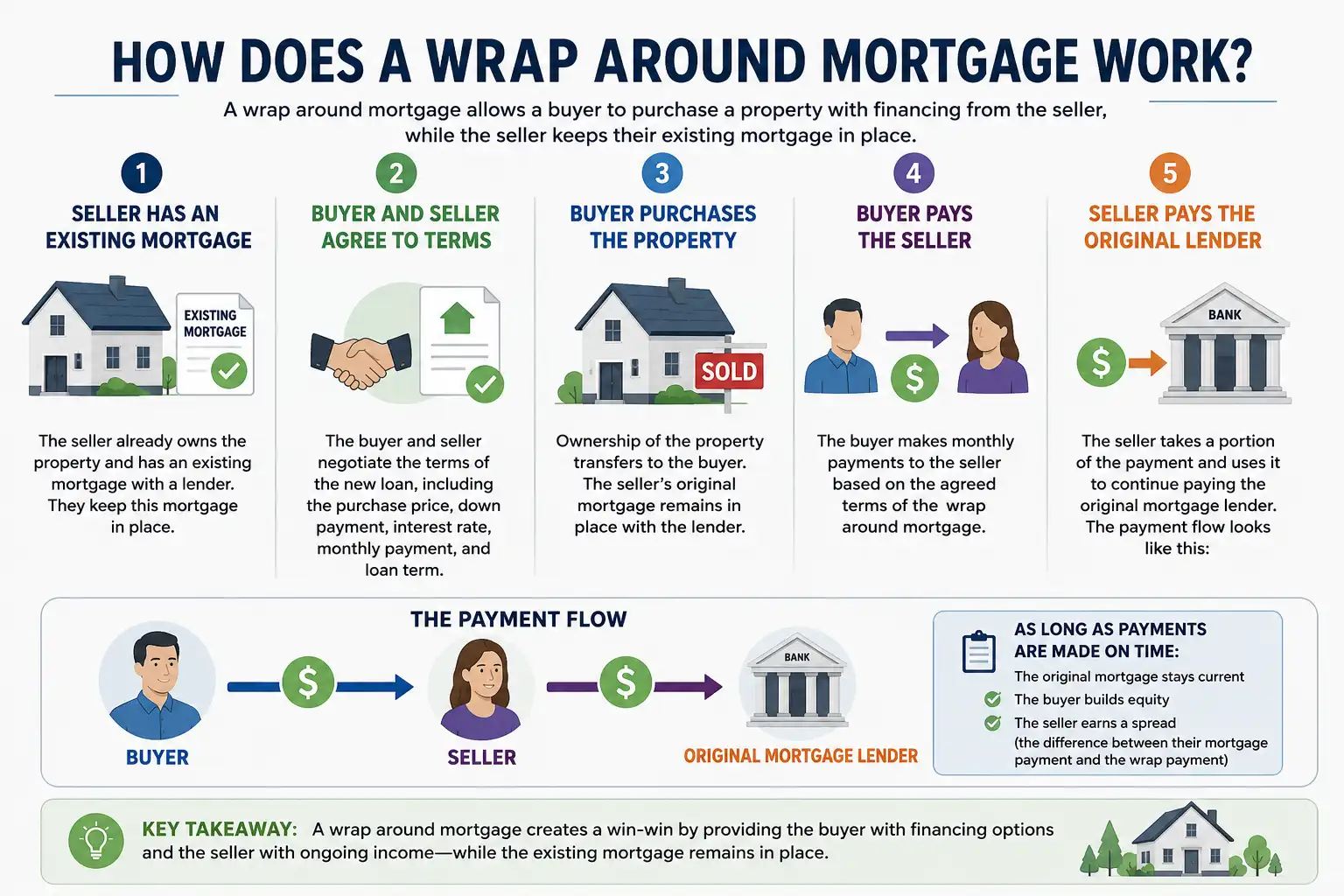
So, what is a wrap around mortgage exactly? In simple terms, a wrap around mortgage is a form of seller financing where the seller keeps their existing mortgage in place and creates a new loan for the buyer that “wraps around” the remaining balance. Instead of making payments directly to a bank, the buyer makes monthly payments to the seller, and the seller continues paying their original lender.
At first glance, wrap around mortgages can sound complicated. And honestly, they can be if they’re not structured correctly. But when used properly, they can create win-win opportunities for both buyers and sellers.
In this guide, we’ll break down everything you need to know about wrap around mortgages, including how they work, real-world examples, the pros and cons, major risks, and how they compare to other creative financing strategies.
At 702 Cash Buyers, creative financing is something we actively use when traditional solutions don’t make sense. While not every situation calls for a wrap around mortgage, understanding how they work can help you determine whether this strategy could be a smart solution for your specific situation.
What Is a Wrap Around Mortgage?
How Does a Wrap Around Mortgage Work?
A wrap around mortgage may sound complicated at first, but the basic concept is actually pretty straightforward once you break it down step by step.
In a traditional home sale, the buyer gets a new mortgage from a bank, the seller gets paid in full at closing, and the seller’s existing mortgage is paid off immediately.
With a wrap around mortgage, that doesn’t happen.
Instead, the seller keeps their existing mortgage in place and essentially becomes the lender for the buyer.
Here’s how the process typically works.
1. The Seller Has an Existing Mortgage: The seller owns a property that still has a mortgage attached to it. Instead of paying off that loan when selling, they leave it in place.
2. The Buyer and Seller Agree to Terms: The buyer wants to purchase the home but may have trouble qualifying for traditional financing or simply wants more flexible terms. The buyer and seller negotiate the terms of the wrap mortgage (Down Payment, Loan Amount, Interest Rates, Terms, etc).
Once both parties agree, the terms are documented in a promissory note and purchase agreement.
3. The Buyer Purchases the Property: After closing, ownership of the property typically transfers to the buyer. Even though the buyer now owns the property, the seller’s original mortgage usually remains in the seller’s name.
4. The Buyer Pays the Seller, and the Seller Pays the Lender: After closing, the buyer makes monthly payments directly to the seller—not the bank. The seller then uses a portion of those payments to continue paying the original mortgage lender.
The payment flow looks like this:
Buyer → Seller → Original Mortgage Lender
As long as payments continue to be made properly, the underlying mortgage stays current.
The seller may also profit from the difference between the original mortgage terms and the new wrap mortgage terms. This difference is commonly called the spread, and it’s one of the main financial incentives behind wrap around financing.
Wrap Around Mortgage Example
Sometimes the easiest way to understand a wrap around mortgage is by seeing a real-world example.
Let’s say Sarah owns a home in Las Vegas that she wants to sell.
Her property is worth $400,000, but she still has an existing mortgage with the following terms:
- Remaining loan balance: $200,000
- Interest rate: 3% fixed
- Monthly mortgage payment: $1,150
Because Sarah locked in a low interest rate a few years ago, her mortgage is extremely attractive compared to today’s market rates.
Now let’s say a buyer named Mike wants to purchase Sarah’s house, but he has trouble qualifying for a traditional bank loan.
Instead of losing the deal, Sarah offers Mike a wrap around mortgage.
They agree to the following terms:
- Purchase price: $400,000
- Buyer down payment: $40,000
- Amount financed through wrap mortgage: $360,000
- Wrap mortgage interest rate: 6.5%
- Loan term: 30 years
Under these terms, Mike’s estimated monthly payment to Sarah would be roughly $2,275 per month (principal and interest only).
Each month, the payment flow looks like this:
Buyer Pays Seller: Mike pays Sarah $2,275/month
Seller Pays Original Lender: Sarah pays her bank $1,150/month
Seller Keeps the Spread: Sarah keeps the difference $2,275 − $1,150 = $1,125/month
That means Sarah earns approximately $1,125 per month in gross cash flow from the spread.
Why does this happen?
Because Sarah’s original mortgage is based on a low 3% interest rate, while the wrap mortgage she created for Mike is based on a higher 6.5% rate on a larger loan amount.
This spread is one of the biggest reasons sellers consider wrap around financing.
In addition to monthly cash flow, Sarah also benefited from:
- Receiving a $40,000 down payment upfront
- Selling the property without waiting for traditional financing
- Expanding her buyer pool
- Potentially selling at full market value or better due to favorable terms
Meanwhile, Mike benefits because he was able to buy a home using creative financing when traditional lending may not have worked for him.
Advantages of a Wraparound Mortgage Loan
A wrap around mortgage can create unique opportunities for both buyers and sellers that may not exist in a traditional real estate transaction.
When structured properly, this type of creative financing can help sellers maximize the value of their existing low-interest mortgage while giving buyers an alternative path to homeownership.
Like most creative financing strategies, the benefits largely depend on each party’s goals and financial situation.
Let’s look at the advantages from both perspectives.
From a Seller's Perspective:
For sellers, one of the biggest advantages of a wrap around mortgage is the ability to turn an existing low-interest mortgage into a valuable financial asset.
Instead of paying off that mortgage immediately during a traditional sale, the seller may be able to leverage it to create additional value.
Some of the biggest benefits for sellers include:
- Monthly cash flow from the spread between the original mortgage payment and the buyer’s payment
- Potential for a higher sale price due to flexible financing terms
- Access to a larger pool of buyers, including those who may not qualify traditionally
- Ability to generate passive income over time
- Greater flexibility when selling difficult or slow-moving properties
In many cases, sellers realize that favorable financing terms can be just as valuable as the purchase price itself.
From a Buyer's Perspective:
For buyers, a wrap around mortgage can provide an alternative financing option when traditional lending isn’t possible or desirable.
Instead of relying on a bank’s strict underwriting requirements, buyers may be able to negotiate directly with the seller for more flexible terms.
Some of the biggest benefits for buyers include:
- Easier qualification compared to conventional loans
- Faster closing without lengthy lender approval processes
- More flexible terms for down payment, interest rate, and repayment
- Potential access to financing despite credit or income challenges
- Opportunity to buy a property when traditional banks say no
This can be especially valuable for self-employed buyers, business owners, freelancers, or anyone with nontraditional income who may struggle with conventional financing requirements.
Disadvantages of a Wraparound Mortgage Loan
While wrap around mortgages can create unique opportunities, they also come with meaningful risks for both buyers and sellers.
This is not a simple real estate transaction, and both parties should fully understand the downsides before entering into one.
Because a wrap around mortgage involves an existing loan, ongoing payment obligations, and legal complexity, problems can quickly arise if the deal is not structured properly.
Let’s look at the potential disadvantages from both sides.
From a Seller's Perspective
For sellers, one of the biggest disadvantages is that they remain legally responsible for the original mortgage—even after selling the property.
That means the seller still carries financial risk.
Some of the biggest drawbacks for sellers include:
- Buyer default risk — If the buyer stops making payments, the seller must still pay the original lender or risk foreclosure
- Ongoing mortgage responsibility even after transferring ownership
- Potential legal costs if enforcement or foreclosure becomes necessary
- More complex paperwork and transaction structuring
- Difficulty exiting the deal early if circumstances change
Another major concern is the due-on-sale clause.
Most conventional mortgages contain a due-on-sale clause, which gives the lender the right to demand full repayment of the loan if ownership transfers without lender approval.
In a wrap around transaction, this means the lender could potentially call the loan due immediately.
While many lenders primarily care that payments are made on time, the risk still exists and should never be ignored.
From a Buyer's Perspective
For buyers, one of the biggest risks is that they are partially dependent on the seller to manage the underlying mortgage properly.
Even if the buyer makes every payment on time, problems can still arise if the seller fails to pay the original lender.
Some of the biggest disadvantages for buyers include:
- Seller payment risk — The seller could collect payments but fail to pay the original mortgage
- Risk of foreclosure, even if the buyer is current on payments
- Potential complications from the seller’s lender enforcing the due-on-sale clause
- Less consumer protection compared to traditional mortgage lending
- Higher interest rates than some conventional financing options
Buyers should also understand that wrap around mortgage agreements can be legally complex.
Because of these risks, both buyers and sellers should strongly consider working with experienced real estate professionals and legal counsel when structuring a wrap around mortgage.
FINAL THOUGHTS
A wrap around mortgage can be a powerful creative financing tool when structured properly.
For buyers, it can create a path to homeownership when traditional financing isn’t available or simply doesn’t make sense. For sellers, it can unlock additional value through monthly cash flow, interest spread, and access to a larger pool of buyers.
That said, wrap around mortgages are not simple transactions. Because these deals involve an existing mortgage, legal documentation, and ongoing responsibilities for both parties, they come with real risks. That’s why understanding the structure of the deal is so important before moving forward.
The biggest takeaway from this guide is this: there is no one-size-fits-all solution in real estate.
Sometimes a traditional cash sale is the best option. Other times, creative financing strategies wrap around mortgages can create better outcomes for everyone involved.
At 702 Cash Buyers, we understand that every homeowner’s situation is unique. We don’t believe in forcing every seller into the same solution. Instead, we take the time to understand your goals and explore the option that makes the most sense for you.
Whether you need to sell quickly for cash, want relief from a burdensome property, or are curious about creative financing options, we’re here to help.
If you’re considering selling your property and want to explore all your options, book a call with 702 Cash Buyers today. We’d be happy to discuss your situation and help you find the best path forward.
FREQUENTLY ASKED QUESTIONS
Is a wrap around mortgage legal?
Yes, wrap around mortgages are generally legal, but they must be structured properly and comply with applicable state and federal laws. Because these transactions involve seller financing, legal documentation, disclosures, and existing mortgage obligations, it’s highly recommended to work with qualified real estate professionals or legal counsel before entering into a wrap agreement.
Is a wrap around mortgage risky?
A wrap around mortgage can carry significant risks for both buyers and sellers if not structured correctly.
Some of the biggest risks include:
- The lender enforcing a due-on-sale clause
- The buyer defaulting on payments
- The seller failing to pay the original lender
- Potential foreclosure issues
- Poorly written legal agreements
While wrap mortgages can offer real advantages, they require careful planning and proper safeguards.
Is a wrap around mortgage the same as seller financing?
Not exactly.
A wrap around mortgage is a type of seller financing, but there’s an important distinction.
With traditional seller financing, the seller usually owns the property free and clear without an existing mortgage. With a wrap around mortgage, the seller still has an active mortgage in place, and the new loan “wraps around” that existing debt.
In short:
- Seller financing = usually no existing mortgage
- Wrap around mortgage = existing mortgage remains
Can a bank call a wrap around mortgage due?
Potentially, yes. Most conventional mortgages include a due-on-sale clause, which gives the lender the right to demand full repayment if ownership transfers without approval.
This means the lender could technically call the loan due after a wrap transaction.
However, whether a lender actually enforces that clause depends on the situation.
Who holds title in a wrap around mortgage?
In many wrap around mortgage transactions, the buyer receives legal title to the property at closing, while the seller remains responsible for the original mortgage.
That means:
- The buyer owns the property
- The seller remains liable for the underlying loan
- The lender still expects payment from the seller
This is one reason trust and proper documentation are so important in wrap transactions.
Can a buyer refinance out of a wrap around mortgage later?
Yes, in many cases.
Some buyers use wrap financing as a temporary solution until they improve their credit, stabilize income, or become eligible for traditional financing.
Once they qualify, they may refinance into a conventional mortgage and pay off the wrap loan entirely.
Learn More About Us!
Come visit us in our About Us page to learn more about your local homebuying couple!
Learn more what our company is all about, we can't wait to chat with you soon 🙂

The Best Way To Sell Your House Fast
Are you looking to sell your house? Our friendly team at 702 Cash Buyers is here to help you through every step of the process. We buy houses in Las Vegas NV. Join our community of satisfied sellers who have successfully sold their houses to us. Let's work together to make your property selling experience easy and stress-free. Click on the button below to get started!